GPT-5.4 Breaks Into Physical Science Labs
We've been watching the evolution of agentic workflows closely, but OpenAI's latest announcement pushes LLMs far past typical software boundaries. In a joint research initiative with Molecule.one, OpenAI connected its GPT-5.4 model to an autonomous high-throughput chemistry lab called Maria. The system didn't just summarize existing research; it independently executed an end-to-end scientific workflow to solve a notoriously difficult problem in medicinal chemistry. If you think LLMs are hitting a data wall, this shift toward physical-world loop integration proves the horizon is shifting toward autonomous discovery.
Summary
On June 17, 2026, OpenAI published research detailing how GPT-5.4, working alongside Molecule.one’s Maria AI, successfully optimized a challenging chemical reaction known as Chan-Lam coupling. This specific reaction is crucial for creating carbon-nitrogen bonds in medicines, but it has historically suffered from low yields when applied to primary sulfonamides-a molecular family essential to oncology and antimicrobial drugs. Synthesis bottlenecks mean scientists can only test what they can successfully make.
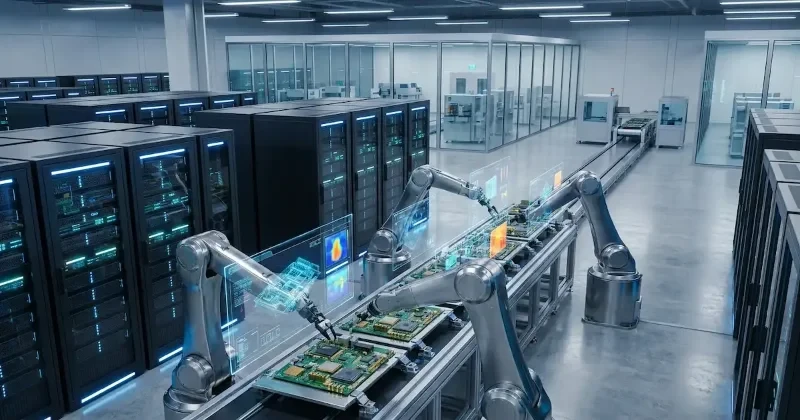
The combined AI system operated in a near-autonomous research loop over a three-month period. GPT-5.4 generated and ranked thousands of research proposals based on scientific prompts. Human chemists acted as supervisors, filtering the top proposals and selecting four for physical testing. From there, Maria AI took over, translating the high-level research plans into precise robotic instructions to run 10,080 high-throughput micro-liter reactions.
The standout proposal, labeled OAI-M1-03, suggested adding mild oxidants like TEMPO to improve the reaction. Across two experimental cycles, Maria Lab executed thousands of tests to validate the hypothesis. The results were definitive: the addition of TEMPO improved yields for 88% of boronic acids and 83% of sulfonamides tested, bumping the mean yield from 16.6% to 25.2%.
Furthermore, follow-up autonomous cycles discovered that TEMPO could be substituted with a significantly cheaper analog, 4-hydroxy-TEMPO, with minimal loss in efficiency. Human chemists later verified these results at standard bench scale, confirming a twofold yield increase in most cases.
Remarks
This is an absolute win for the developer and scientific ecosystem, representing a major validation of agentic infrastructure. For years, skeptics argued that LLMs were merely stochastic parrots incapable of genuine innovation. This research directly refutes that narrative. GPT-5.4 didn't just regurgitate a textbook; it analyzed literature, proposed an unexpected additive, adjusted variables based on noisy lab data, and optimized costs by finding a cheaper chemical alternative.
We predict that this will spark a massive wave of specialized "agent-to-hardware" SDKs. Just as the industry standardized on tools like LangChain for digital orchestration, we will soon see open-source orchestration layers designed specifically to bridge LLM APIs with physical infrastructure, laboratory robotics, and manufacturing systems.
This approach contrasts sharply with previous iterations like GPT-5 or specialized scientific models like GPT-Rosalind, which primarily acted as retrieval or narrow prediction assistants. By pairing a frontier foundation model with Molecule.one's execution-focused Maria AI, OpenAI avoided building a monolithic "scientist model". Instead, they proved that a modular architecture-where a generalized reasoning engine drives a highly specialized local agent-is the fastest path to achieving complex, real-world automation.
| Metric | Baseline Conditions | AI-Optimized Conditions (TEMPO Additive) |
| Mean Reaction Yield | 16.6% | 25.2% |
| Share of Reactions Above 30% Yield | 15.6% | 37.5% |
| Substrate Success Rate (Boronic Acids) | N/A | 88% improvement |
| Substrate Success Rate (Sulfonamides) | N/A | 83% improvement |
OpenAI’s collaboration with Molecule.one proves that the true power of frontier models lies in breaking out of the sandbox and interacting with physical infrastructure. By treating the LLM as a reasoning engine and pairing it with robotic automation, they unlocked an entirely new scale of scientific discovery. This isn't just an update for chemists; it is a massive signal to the developer community that the next frontier of software engineering is deeply physical. We will continue tracking how these multi-agent physical deployments evolve.