DiffusionGemma Parallel Generation Upends Standard LLM Inference
We’ve been watching the slow, sequential drip of autoregressive text generation bottleneck local hardware for years. That familiar typewriter effect looks smooth to an end-user, but for developers building complex agentic loops or low-latency local assistants, waiting on memory-bound token-by-token generation is a massive performance drag.
Google DeepMind and NVIDIA just flipped the script by launching DiffusionGemma, an experimental open model designed to generate massive blocks of text simultaneously. Optimized directly for NVIDIA RTX GPUs, RTX PRO platforms, and DGX Spark systems, this model bypasses traditional token pipelines to bring high-throughput, low-latency text generation directly to local developer environments.
Summary
Rather than predicting a single token at a time, DiffusionGemma processes text the way image generation architectures handle pixels. It starts from random noise and refines text blocks in parallel, denoising up to 256 tokens per processing step. This design completely changes the underlying compute workload.
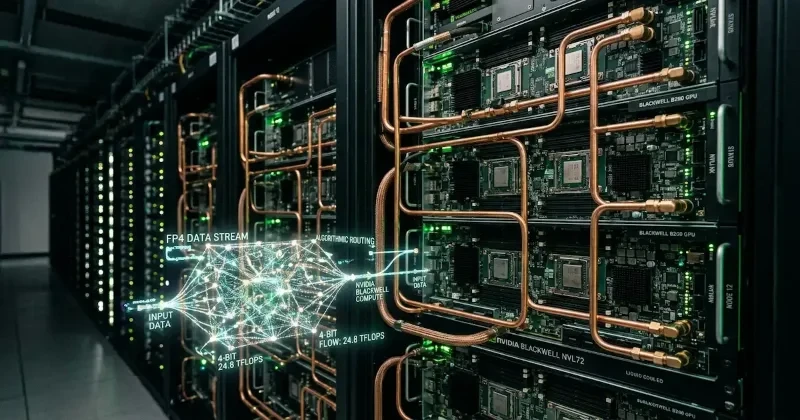
Traditional large language models spend the majority of their cycles waiting on memory bandwidth rather than executing mathematical calculations. Because DiffusionGemma pulls an entire 256-token block through its transformer layers at once, it shifts the inference profile from a memory-bound problem to a compute-bound problem. This structure allows NVIDIA Tensor Cores and the CUDA stack to maximize raw computational throughput right out of the box.
Architecturally, the model is built on top of Google’s Gemma 4 26-billion-parameter mixture-of-experts (MoE) design. It couples a dedicated diffusion head with the MoE base, activating only 3.8 billion parameters per step to remain highly efficient.
The raw performance gains on local hardware are significant. According to benchmark data, the model delivers roughly a 4x performance increase compared to equivalent autoregressive setups under single-user workloads.
It hits 150 tokens/sec on deskside DGX Spark systems, ramps up to 1,000 tokens/sec on a single enterprise H100 GPU, and tops out at 2,000 tokens/sec on a DGX Station. Released under a permissive Apache 2.0 license, the open weights feature immediate day-zero support across Hugging Face Transformers, vLLM, and Unsloth.
Remarks
This is a massive win for the open-source developer ecosystem. For months, the industry has thrown raw parameters or complex quantization schemes at the latency problem, while ignoring the core architectural bottleneck of autoregressive decoding. By proving that text diffusion can scale effectively via an MoE backbone, Google DeepMind and NVIDIA are opening up a completely separate avenue for model training and deployment.
We predict this will trigger a wave of block-based diffusion variants from competitor ecosystems. While OpenAI and Anthropic lock their highest-throughput reasoning models behind cloud APIs, the local-first nature of DiffusionGemma gives independent developers a powerful alternative for specialized tasks.
Comparing this to standard Gemma architectures or traditional llama.cpp deployments, the shift from memory-bound to compute-bound performance means we are finally utilizing the full potential of consumer and enterprise GPU architectures. It changes local hardware from a constrained sandboxing environment into a high-speed production engine.
| Hardware Platform | Architecture / Specs | Token Throughput Performance |
| NVIDIA DGX Spark | GB10 Grace Blackwell / 128GB Unified Memory | 150 tokens/sec |
| NVIDIA H100 GPU | Single Enterprise Tensor Core GPU | 1,000 tokens/sec |
| NVIDIA DGX Station | Enterprise Infrastructure / 748GB Coherent Memory | 2,000 tokens/sec |
DiffusionGemma breaks the mold of standard token generation. By turning local inference into a compute-bound task, Google and NVIDIA have delivered a practical path forward for high-speed, local agent deployment. As developer pipelines shift toward complex autonomous loops, architectures that respect hardware efficiency will inevitably win out over brute-force scaling methods. We will be tracking how the community adapts this block-generation framework over the coming months.